
The beleaguered Deutsche Bank announced major overhaul of its business, which included discontinuing loss-making equities trading business, creating a new 'bad bank', and cutting 18,000 jobs. Deutsche Equities India employs 35 people, all of whom could face the job axe.

The tribunal, while adjourning the matter for September 16, directed Sebi to file a reply and gave three weeks to the Roys to file a rejoinder.

Most brokerages have maintained their Sensex and Nifty targets as they believe there is little room for further re-rating in the backdrop of weak earnings.

Market players said a big upmove by the market will depend on policy action by the government to revive economic growth and corporate earnings revival.

There is a near consensus that at least a 25 basis points cut, if not 50, can be expected in the June policy.

Monsoons have had limited effect on market returns for a given year, report Sachin Mampatta and Sundar Sethuraman.
75 companies can dole out Rs 1.1 trillion from the 'extra cash' to shareholders.

NSE's board was to approve on Friday the annual financial statement for the year ended March 31, 2019, but it decided to defer the matter till its legal team firmed up a view on Sebi's order, sources said.

Based on a feedback, the exchange could cap a sector's weight at 25 per cent, or align with the broader market.

The number of issues were the lowest since FY15, compared to 45 in FY18.

Starting April 1, a non-executive director of 75 years or more can be appointed or re-appointed only by way of a special resolution, which requires 75 per cent 'for' votes.
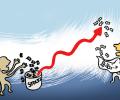
So far in 2019, India has been one of the highest recipients of foreign flows among Asian and Emerging Market (EM) economies

While discount brokers have managed to grow at a rapid pace, they have not been successful in capturing substantial market share in the above-40 age category.

While divestment through IPOs saw an over 90 per cent drop as compared to the previous financial year, the exchange traded fund (ETF) route proved to be a shot in the arm for the government, reports Sundar Sethuraman.
A surge in foreign inflows is seen as the major reason behind the latest market surge.

The offering comprises secondary sale of 13.68 million shares, constituting 27.3 per cent stake.

Experts say foreign investor sentiment was bolstered by the US Federal Reserve's decision to go slow with interest rate hikes and hopes of political stability.
India now has three companies in the global top 100 list in terms of market value: Reliance Industries (RIL) ranks 72, Tata Consultancy Services (TCS) is at 86 and HDFC Bank at 99.

Global funds have pumped in over Rs 38,000 crore (about $5.5 billion) into domestic equities since February 20, helping the Sensex rebound 2,671 points, or 7.6 per cent, from its 2019 low.

The mid- and small-cap indices had a dream run between January 2017 and January 2018 - zooming 48 per cent and 56 per cent, respectively.
 © 2026 Rediff.com - Investor Information - Advertise with us - Disclaimer - Privacy Policy - Sitemap - Feedback - About us - Terms of use - Grievances